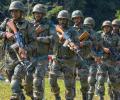
A digital memorial in Iraq now commemorates 33,000 Indian Army soldiers who died in the First World War, addressing a historical omission from the Basra Memorial.

Markets face risk of a prolonged bear phase as oil shocks and geopolitical tensions test inflation, growth and investor confidence globally, points out Debashis Basu.

'Even if the war ends tomorrow, which is unlikely, and we go back to the pre-war status quo, the world will still need some time to get over the sudden shock of oil price increases.'

An explainer on the 'Thucydides Trap' and its relevance to current tensions between the United States and China, as discussed by President Xi Jinping.

'Markets never fully lose hope. But an important shift could come if the Strait remains closed -- moving from high prices to no prices.'

India is one of the few nations, and perhaps the only nation, that has good relations with America, Israel and Iran. Knowing that a war in the Gulf would damage our economy, hurt supply of fertilisers and fuel, and cause general chaos, we should have tried to ensure this war did not begin, asserts Aakar Patel.

India should not stay on the margins of this initiative. There should be a serious debate about what would be in India's best interests asserts former foreign secretary Shyam Saran.

Karex, the Malaysian company that makes roughly one in five of the world's condoms -- about five billion a year, supplying Durex and Trojan among others -- announced this week that it is raising prices by up to 30 percent. The reason is the Strait of Hormuz.

The purge in Washington does not pause the war. Strikes continue, Hormuz remains closed, and Brent crude is still dancing around $109 a barrel. For India, the command chaos in the Pentagon is another layer of uncertainty piled on five weeks of conflict that was already straining every buffer Delhi has.

Both sides have now revealed a preference for escalation over strategic defeat, and each new provocation narrows the space for the next pause. The Touska seizure, Iran's refusal to negotiate under blockade, Israel's strikes on Iranian oil infrastructure -- all of these add up to an increasingly untenable situation. This makes the wild card -- Trump and his motormouth -- more consequential than ever, notes Prem Panicker in his must read blog on the Iran War.

Nobody takes Pakistan seriously and therefore Pakistan's sudden mediating with almost immediate results of a ceasefire seems more contrived than real, points out Vice Admiral Biswajit Dasgupta (retd).

Donald Trump is claiming he prevented a war between India and Pakistan, a statement that has been repeatedly made by the former US President despite denials from India.

America's population and its media and its democratic structures seem fine with this, which is why Trump continues as he does, asserts Aakar Patel.

Chaffing under public ridicule in the US as well as internationally for having 'lost' the war, Trump is under immense pressure to do something, cautions Ambassador M K Bhadrakumar.
The logic of war plus the gathering storms in US politics as the midterms loom large leave him with no real alternative but to negotiate, points out Ambassador M K Bhadrakumar.

'India's ties with Israel have to do with defence and general technology.' 'The war changes nothing in what India and Israel hope to get from the relationship.' 'It's not as though India will get significantly more benefits from Iran if India abandons Israel at this time.'

'American stature has been reduced because they have not been able to achieve their aims.'

Italy rejects a proposal by Trump envoy Paolo Zampolli to replace Iran at the FIFA World Cup 2026, as officials insist qualification must be earned on merit.

The big question is whether Trump is any longer in command of the situation. For all practical purposes, the war seems set to cascade as the US is preparing for a potential ground operation in Iran and threatens to destroy 'bridges next, then electric power plants', points out Ambassador M K Bhadrakumar.

Israel's Defence Minister Israel Katz has stated that Israel is prepared to escalate military action against Iran, pending approval from the United States. This comes as US President Donald Trump says he would not use nuclear weapons in any conflict with Iran, while also claiming the US has 'total control' over the Strait of Hormuz.

US defence officials confirmed that an F-35 did perform an emergency landing after an Iranian surface-to-air missile (SAM) barrage, with the pilot safe and an investigation underway.

US President Donald Trump and Chinese President Xi Jinping met in Beijing to discuss a range of issues, including trade frictions and the war in Iran.

US President Donald Trump will visit China from May 13 to 15 at the invitation of President Xi Jinping. The visit occurs amidst global tensions, including the war in West Asia and trade disputes between the US and China. Discussions are expected to cover China-US relations, world peace, and economic issues.

Pope Leo XIV on Monday underscored his commitment to spiritual advocacy over political friction, stating that he has no desire to engage in a confrontation with the US administration.


At least 101 people are missing and 78 are injured after a suspected submarine attack on an Iranian naval ship off Sri Lanka's southern coast on Wednesday, Reuters quoted sources in Sri Lanka's Navy and defence ministry as saying.

Trump says Putin and Zelenskyy would be stupid if they don't end the war now, and that he knows they are not stupid.

16 days into the war, US forces were already running out of ground-attack missiles and Israel is about to expend its entire Arrow interceptor missiles by end March. To be sure, the Iranians are watching closely and that explains their defiant stance that 'Iran will end the war when it decides to do so and when its conditions are met', notes Ambassador M K Bhadrakumar.

Aamir Khan's upcoming film, aims to shed light on the 1952-1953 India-Pakistan series, which occurred just five years after Partition and marked Pakistan's first official Test series.

'Every day the meter is ticking. Like a time bomb.' Shipping giants are billing Indian exporters up to $3,000 per container in war surcharges -- on cargo that sailed before the war began -- as the Strait of Hormuz shuts down.

The question is no longer whether the war will expand. It has. The next few days will tell us whether the war stabilises around Hormuz or whether the Strait itself becomes the trigger for a far larger rupture. What to watch for over the next 48 hours is simple: Any move by the US toward direct naval control of the Strait; any credible Iranian attempt to disrupt or mine shipping lanes and, critically, whether energy infrastructure in the Gulf continues to be targeted.If those lines are crossed in tandem, the war will no longer be containable within the region.

US President Donald Trump received a red carpet welcome in Beijing for talks with Chinese President Xi Jinping on trade, the Iran war, and other key issues. The visit underscores the importance both nations place on their relationship amid ongoing tensions.

What we are watching is something different: A fog manufactured and maintained by the people who started the war, so that the question of why it was started never has to be answered, observes Prem Panicker in his must read blog on the war in the Middle East.

US President Donald Trump is set to visit China for talks with President Xi Jinping on trade, global issues, and the Gulf war. The visit aims to address trade frictions and other key issues, with high expectations for progress.

The United States, which entered this war in expectation of a short, sharp win along the Venezuela model, is now preparing for deeper involvement in a conflict it does not fully control, without the allies it typically relies on, against an adversary that is not behaving as expected, in a global environment that is already absorbing economic shock. Prem Panicker continues his must read daily blog on the Gulf War.

When everyone has footage and no one can verify it, the loudest voice wins, notes Prem Panicker who begins a daily blog on the War in the Middle East.
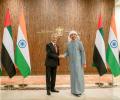
Frankly, was it really necessary in the middle of a fratricidal war for External Affairs Minister S Jaishankar to travel to Abu Dhabi for a one-on-one with the sheikh on April 12?Or, for National Security Advisor Ajit Doval to follow up on April 26? Or, for PM Narendra Modi to follow through today? There are no easy answers, notes Ambassador M K Bhadrakumar.

'The people who are outraging, they don't have any substantial argument. They are enraging over manufactured memes and manufactured figures.'

US President Donald Trump has announced plans to clear the Strait of Hormuz to secure the vital oil corridor, citing risks to global energy supplies and criticising other nations' inaction.

Chinese President Xi Jinping warned US President Donald Trump that mishandling the Taiwan issue could trigger conflicts between the two countries during wide-ranging talks on trade, Iran, and energy security.
 © 2026 Rediff.com - Advertise with us - Disclaimer - Privacy Policy - Sitemap - Feedback - About us - Terms of use - Grievances